If you’ve ever spent a Sunday evening rebuilding an invoice from a Word template, chasing a client who “never received” the PDF you sent three times, or realizing mid-tax-season that you have no idea how much you actually earned last quarter — you already understand the problem invoicing software solves.
For freelancers, getting paid isn’t just a financial task. It’s a workflow. And the tools you use to manage that workflow directly affect your cash flow, your time, and how professional you appear to clients. This guide breaks down the 10 most important benefits of invoicing software for freelancers — and helps you decide whether it’s time to stop doing this manually.
What Is Invoicing Software and What Does It Do?
Invoicing software is a tool that automates the creation, delivery, tracking, and management of invoices between you and your clients. At its most basic, it replaces Word or Excel templates with a faster, smarter system. At its most powerful, it handles recurring billing, payment collection, late payment reminders, expense tracking, and financial reporting — all from one dashboard.
For freelancers specifically, the best invoicing tools also integrate with payment processors like Stripe and PayPal, connect to accounting software like Xero or QuickBooks, and work across desktop and mobile so you can send an invoice the moment a project is complete — not three days later when you’re back at your desk.
Popular options include FreshBooks, Wave, Zoho Invoice, Invoice Ninja, and HoneyBook. Some are free; others start at $9–$19/month. The right choice depends on how you bill, how many clients you manage, and whether you need invoicing alone or a broader billing suite.
What Is Invoicing and Why Is It Important for Freelancers?
An invoice is a formal document you send to a client requesting payment for services rendered. It records what work was done, how much is owed, and when payment is due. For freelancers, invoicing is the bridge between completing work and getting paid — and how you manage that bridge has real consequences.
Poor invoicing practices lead to late payments, missed income, and disputes over what was agreed. According to the UK government’s own estimates, small businesses are owed over £20 billion in unpaid invoices at any given time — and a 2025 FSB/GoCardless report found that 45% of UK small businesses are experiencing more late payments than the year before, with 52% regularly forfeiting overdue payments entirely just to avoid the time and cost of chasing them. In the US, the average freelancer waits 30–90 days beyond invoice due dates for payment on at least one client per year.
Invoicing software doesn’t just make the process faster — it makes it more professional, more consistent, and significantly more likely to result in on-time payment.

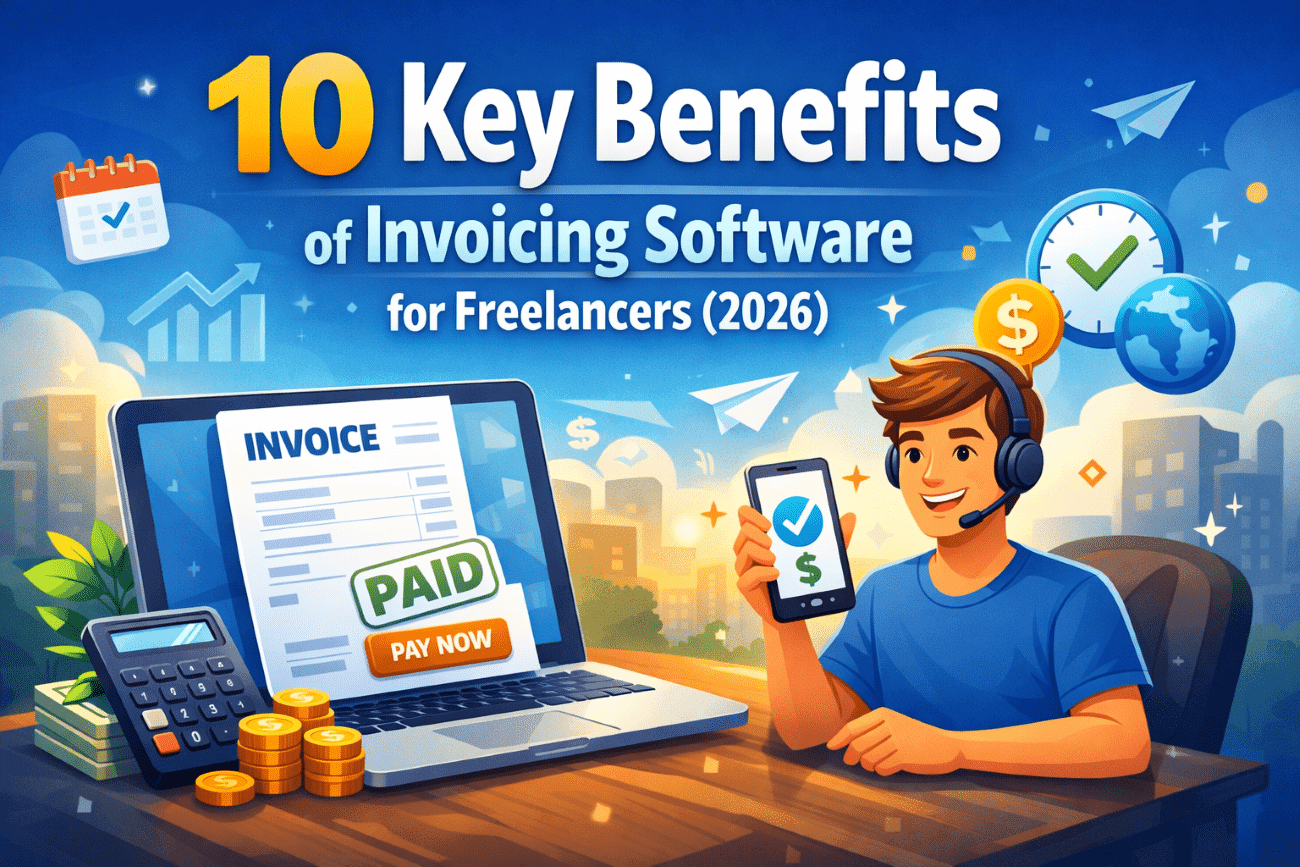
10 Key Benefits of Invoicing Software for Freelancers
1. You Get Paid Faster
This is the most immediate and measurable benefit. Invoicing software sends professional, clearly formatted invoices the moment work is complete — not days later when you finally find time to open a spreadsheet. Many platforms also include a “Pay Now” button linked directly to Stripe or PayPal, which removes every possible friction point between your client deciding to pay and the money hitting your account.
In practice, freelancers who switch from manual invoicing to dedicated software consistently report getting paid 7–14 days faster on average — simply because the invoice arrives sooner and the payment process is easier for the client.
2. Automatic Payment Reminders Save You From Awkward Follow-Ups
Chasing late payments is one of the most uncomfortable parts of freelancing. Most people avoid it for too long — and then the payment gets even later. Invoicing software solves this by sending automated reminders on your behalf: three days before the due date, on the due date, and at intervals after it.
The reminder goes out automatically, it looks professional, and it comes from your business — not from you personally apologizing for asking. This small shift in dynamic makes a significant difference in how quickly clients respond.
3. Professional Invoices Build Client Trust
A cleanly formatted invoice with your logo, your business name, itemized line items, and a clear payment due date signals that you run a real business — not a side hustle. For freelancers competing for higher-value clients, this matters more than most people realize. Clients who perceive you as professional are more likely to pay on time, refer you to others, and treat your rates as non-negotiable.
Most invoicing tools let you customize templates with your branding in under ten minutes, and every invoice you send after that reinforces that professional image automatically.
4. You Always Know What’s Paid, Pending, and Overdue
With manual invoicing, tracking payment status means cross-referencing email threads, bank statements, and spreadsheets. It’s slow, error-prone, and easy to let things slip through. Invoicing software gives you a real-time dashboard showing every invoice’s status — sent, viewed, paid, overdue — at a glance.
This alone removes hours of admin per month and eliminates the anxiety of not knowing where your money is.
5. Recurring Invoices Remove Repetitive Work
If you have retainer clients who pay the same amount every month, invoicing software lets you set up recurring invoices that generate and send automatically on a schedule you define. You set it once; the invoice goes out every month without you touching it.
For freelancers with even two or three retainer clients, this can save 30–60 minutes every billing cycle — and ensures the invoice never gets delayed because you were busy with a project deadline.
🔍 Looking for the right tool? Jump to our invoicing software comparison table below to see which platform best fits your workflow, budget, and billing style.
6. Expense Tracking Captures Every Deductible Cost
Many invoicing tools — particularly FreshBooks and Harvest — include built-in expense tracking that lets you photograph receipts, categorize costs, and attach expenses directly to client projects. This matters enormously at tax time: freelancers who track expenses properly throughout the year claim significantly more in deductions than those who reconstruct everything from bank statements in January.
In practice, missing even a few months of expense tracking can cost you hundreds of dollars or pounds in unclaimed deductions — far more than the cost of the software itself.
7. Time Tracking Turns Every Hour Into Billable Revenue
For freelancers who bill hourly, time tracking built into invoicing software closes the gap between hours worked and hours billed. Tools like FreshBooks and Harvest let you start a timer against a specific project, and when invoice time comes, those hours populate automatically — no manual calculation required.
Freelancers who implement time tracking consistently report recapturing 15–25% more billable hours than they were previously invoicing, simply because small tasks — emails, revision rounds, brief calls — were never being counted before.
8. Multi-Currency Support Means You Can Work With Anyone
Freelancers increasingly work with clients across the US, UK, Europe, and Australia simultaneously. Invoicing software with multi-currency support lets you bill each client in their local currency, handles conversion automatically, and ensures your records stay clean regardless of how many currencies are flowing through your business.
Without this, international invoicing becomes a manual calculation exercise that introduces errors and confusion on both sides.
9. Tax Preparation Becomes Significantly Less Painful
At the end of the financial year, freelancers using invoicing software can generate a complete profit and loss summary, export categorized income and expense reports, and hand their accountant clean, organized records — instead of a folder of receipts and a spreadsheet that needs cleaning up.
In the US, this translates directly to easier Schedule C preparation. In the UK, it simplifies self-assessment filing and supports Making Tax Digital (MTD) compliance. Either way, the time saved — and the accountant fees reduced — are real and immediate.
10. You Spend Less Time on Admin and More Time on Billable Work
This is the compounding benefit that all the others feed into. Every hour you spend manually creating invoices, chasing payments, reconciling records, and preparing tax documents is an hour you’re not billing a client. Invoicing software compresses all of that admin into a fraction of the time — typically reducing financial admin from four to eight hours per month down to under one hour for most solo freelancers.
Over a year, that’s 36–84 hours returned to billable work. At even a modest hourly rate of $50, that’s $1,800–$4,200 in recaptured earning capacity — from a tool that costs $0–$19/month.
Do I Need Invoicing Software as a Freelancer?
The honest answer: it depends on where you are in your freelance practice — but the bar is lower than most people think.
If you have more than two active clients, bill more than twice a month, or have had even one late payment situation, dedicated invoicing software will save you more time and money than it costs within the first 30 days. The free plans from Wave and Zoho Invoice are genuinely functional — meaning you can get all the core benefits above at zero cost.
The only scenario where manual invoicing still makes sense is if you have one client, invoice once a month, and have a perfectly reliable payment history. Once any of those conditions change, the case for software is immediate.
Best Invoicing Software for Freelancers: Quick Comparison
| Tool | Best For | Starting Price | Free Plan | Time Tracking | Multi-Currency | Best Region | Mobile Rating |
|---|---|---|---|---|---|---|---|
| FreshBooks | Hourly billing freelancers | $19/mo | ❌ | ✅ Yes | ✅ Yes | 🇺🇸 US / 🇬🇧 UK | ⭐ 4.8/5 |
| Wave | Budget-conscious freelancers | Free | ✅ Yes | ❌ No | ❌ USD only | 🇺🇸 US / 🇨🇦 CA | ⭐ 4.6/5 |
| Zoho Invoice | Free + multi-currency | Free | ✅ Yes | ✅ Yes | ✅ Yes | 🌍 Global | ⭐ 4.8/5 |
| HoneyBook | Creative freelancers | $19/mo | ❌ | ❌ No | ❌ USD only | 🇺🇸 US only | ⭐ 4.5/5 |
| Invoice Ninja | Free up to 5 clients | Free / $10/mo Pro | ✅ Yes | ✅ Yes | ✅ Yes | 🌍 Global | ⭐ 4.4/5 |
| Harvest | Hourly billing + invoicing | $11/user/mo | ✅ Limited (2 projects) | ✅ Yes | ✅ Yes | 🇺🇸 US / 🇬🇧 UK | ⭐ 4.5/5 |
For US and Canadian freelancers starting out: Wave (free, clean UX, built for North America) or Zoho Invoice (free, multi-currency, global). For UK freelancers needing MTD compliance: FreshBooks or Xero. For freelancers billing hourly who want time tracking and invoicing in one place: FreshBooks or Harvest.
What Are the Benefits of Accounting Software vs Invoicing Software?
This question comes up often — and the distinction matters. Invoicing software focuses specifically on creating, sending, and tracking invoices and payments. Accounting software does all of that plus bank reconciliation, financial statements, payroll, and full tax reporting.
For most solo freelancers, dedicated invoicing software is enough — especially when paired with a basic spreadsheet or free accounting tool for annual tax prep. If you’re earning above $50,000/year, have multiple income streams, or need formal financial statements for a business loan or investor, a full accounting tool like Xero or QuickBooks makes more sense.
The good news: several tools (FreshBooks, Harvest, Zoho Books) bridge both categories — offering invoicing-first experiences with enough accounting depth to handle most freelancer needs without upgrading to enterprise software.
For UK Freelancers: Making Tax Digital and Self-Assessment
If you’re a freelancer based in the UK, invoicing software carries an extra layer of relevance that goes beyond convenience. HMRC’s Making Tax Digital (MTD) initiative is progressively requiring self-employed individuals and landlords to keep digital records and submit tax returns via MTD-compatible software. From April 2026, this requirement extends to sole traders and landlords with income over £50,000 — and from April 2027, to those earning over £30,000.
What this means practically: manual invoicing and spreadsheet-based records are becoming increasingly non-compliant for UK freelancers at any meaningful income level. Tools like FreshBooks, Xero, and Zoho Invoice are all MTD-compatible, meaning the records you keep inside them are already formatted correctly for HMRC submission.
Beyond compliance, UK freelancers benefit from invoicing software’s self-assessment support: automatic income categorization, expense summaries, and year-end profit and loss reports that translate directly into the numbers your accountant needs for your annual return — or that you need if you file yourself.
When You Don’t Need Invoicing Software
Not every freelancer needs a dedicated tool — and being honest about that actually helps you make a better decision. You can probably skip invoicing software if:

- You have one client on a fixed monthly retainer who pays consistently and on time
- Your agency or employer handles all billing on your behalf
- You earn under $5,000/year from freelance work and file it as occasional income
- You’re in a trial period with a new client before committing to a longer engagement
Once any of those conditions change — a second client, a late payment, a tax question you can’t answer — the case for software becomes immediate. And since free options exist, there’s no financial barrier to starting.
Real Freelancer Scenario: From Excel Chaos to Paid on Time
Consider a freelance graphic designer based in Chicago billing three clients at roughly $3,500/month total. She was managing invoices in Excel, sending them manually via email, and tracking payments in a separate Google Sheet. Every billing cycle took her around 90 minutes — and she was consistently waiting 25–35 days for payment on at least one invoice per month.
After switching to FreshBooks, her invoicing time dropped to under 15 minutes per cycle. Automated payment reminders went out on day 7 and day 14 after each invoice — and her average payment time dropped from 28 days to 11 days within the first two months. At her effective rate, those 17 recovered days translated to better cash flow planning and eliminated the need for a buffer loan she’d been relying on to cover slow months.
The tool cost her $19/month. The improvement in cash flow was worth multiples of that in the first 60 days.
FAQ
1. What are the main benefits of invoicing software for freelancers?
The core benefits are faster payment, automatic reminders, professional presentation, real-time payment tracking, recurring invoice automation, and significantly reduced financial admin time. Together, these translate directly into better cash flow and more hours available for billable work.
2. Is invoicing software worth it if I only have a few clients?
Yes — especially since free options like Wave and Zoho Invoice exist. Even with two clients, automated reminders and professional invoice templates improve payment speed and reduce the awkwardness of chasing late payments. There’s no cost threshold that justifies staying manual.
3. What is the best free invoicing software for freelancers?
Zoho Invoice is the strongest free option for most freelancers — it includes time tracking, multi-currency support, and automated reminders at no cost. Wave is the best choice for US-based freelancers who prioritize a clean, simple interface. Both are genuinely functional on their free plans indefinitely.
4. Does invoicing software help with taxes?
Significantly. Most invoicing tools generate income summaries, expense reports, and profit & loss statements that make tax preparation much faster and more accurate. In the UK, tools like FreshBooks and Xero also support Making Tax Digital (MTD) requirements. In the US, the reports map directly to Schedule C categories for sole proprietors.
5. What is the difference between invoicing software and accounting software?
Invoicing software manages the billing side of your business — creating invoices, tracking payments, and automating reminders. Accounting software covers a broader set of financial functions including bank reconciliation, balance sheets, payroll, and formal financial reporting. For most freelancers, invoicing software (or a hybrid tool like FreshBooks) is sufficient. Full accounting software becomes necessary as income complexity increases.
The Bottom Line
The benefits of invoicing software for freelancers aren’t abstract — they show up in your bank account, your time, and your stress levels within the first month of use. Faster payments, less admin, cleaner tax records, and a more professional image with clients are all tangible outcomes that directly affect your bottom line.
If you’re still invoicing manually, the switch takes less than an hour to set up. Start with a free plan — Zoho Invoice or Wave — and run it for 30 days. The difference in how much time you spend on billing, and how quickly clients pay, will be immediately obvious.
Your time is billable. Your invoicing process should reflect that.