Running a small business means wearing every hat — sales, delivery, customer service, and finance. Most small business owners don’t have a dedicated accountant on staff. They’re managing their own books, often late at night, often in a spreadsheet that’s one wrong formula away from a financial mystery.
The right accounting software for small businesses doesn’t just organize your numbers — it gives you visibility, control, and time back. According to a 2025 US Chamber of Commerce report, accounting software is now the most widely adopted business technology after social media and payment platforms. Over 55% of small businesses in the US have already made the switch to cloud-based accounting tools — and the gap between those who have and those who haven’t is showing up directly in time spent, errors made, and tax bills paid.
This guide covers the 12 most impactful benefits, what they mean in practice, and which tools deliver them best for small businesses in the US, UK, Canada, and Australia.
Jump ahead: → See the best accounting software for small businesses compared
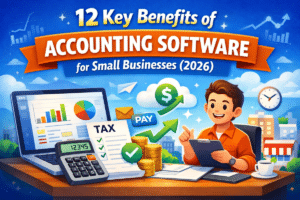
12 Key Benefits of Accounting Software for Small Businesses
1. Saves Significant Time on Financial Admin
Manual bookkeeping — entering transactions by hand, reconciling bank statements line by line, calculating totals in spreadsheets — is one of the most time-consuming tasks a small business owner faces. Accounting software eliminates the majority of this work through bank feed integration, which pulls transactions directly from your business account and categorizes them automatically.
In practice, small business owners who switch from manual bookkeeping to cloud accounting software consistently report reducing their monthly financial admin from 8–12 hours down to 1–2 hours. That’s a full working day returned to revenue-generating activity every month — without hiring anyone.
2. Dramatically Reduces Costly Errors
Human error in manual bookkeeping isn’t a question of competence — it’s a function of volume. The more transactions you process, the more opportunities there are for typos, miscalculations, and missed entries. These errors compound: a single miscategorized expense can distort your profit and loss statement, affect your tax return, and lead to decisions based on numbers that don’t reflect reality.
Accounting software eliminates data entry errors by pulling transactions directly from bank feeds, performs all calculations automatically, and flags anomalies — like duplicate entries or unusual transactions — before they become problems. QuickBooks Online, for example, includes AI-powered anomaly detection that analyzes over a year of financial data to identify irregularities in real time.
3. Real-Time Financial Visibility
One of the most underappreciated benefits of accounting software is knowing, at any moment, exactly where your business stands financially. How much revenue have you made this month? What are your biggest expense categories? Are you on track to cover next month’s bills? With manual bookkeeping, these questions require calculation. With accounting software, the answer is on your dashboard before you’ve finished your coffee.
This real-time visibility changes how small business owners make decisions — about hiring, pricing, investment, and cash flow management — because those decisions are based on current data rather than figures from last month’s spreadsheet update.
4. Simplifies Tax Preparation Enormously
For most small business owners, tax season is a source of genuine dread — primarily because it involves reconstructing a year’s worth of financial activity from imperfect records. Accounting software solves this at the source: every transaction is categorized as it happens, receipts are attached digitally, and reports are generated instantly.
In the US, software like QuickBooks automatically maps expenses to Schedule C categories for sole proprietors and generates 1099 contractor reports. In the UK, FreshBooks and Xero are Making Tax Digital (MTD) compliant, meaning your records are already in the format HMRC requires. In Canada, Wave’s HST tracking handles quarterly remittances cleanly. In Australia, Xero’s BAS preparation is the industry standard. The common outcome: tax preparation that used to take days takes hours — and your accountant spends their time on strategy rather than data cleanup.
5. Improves Cash Flow Management
Cash flow is the leading cause of small business failure — not profitability, not market fit, but running out of cash at the wrong moment. Accounting software addresses this directly by giving you a clear, real-time picture of money coming in (invoices sent, payments received, receivables outstanding) and money going out (expenses, bills due, payroll upcoming).
Tools like Xero include cash flow forecasting features that project your balance weeks ahead based on current data, so you can see a cash shortfall coming and act before it arrives — not after. This capability alone has prevented more small business crises than any other single feature in the accounting software category.
6. Faster Invoice Creation and Payment Collection
For small businesses that invoice clients — consultants, agencies, contractors, service providers — accounting software with built-in invoicing dramatically accelerates the billing cycle. Invoices are created from templates in minutes, sent directly from the platform, and include a “Pay Now” button linked to Stripe, PayPal, or direct bank transfer.
The impact on payment speed is measurable. Businesses using automated invoicing with online payment options consistently report getting paid 7–14 days faster than those sending manual PDF invoices. At the scale of a small business managing 10–20 invoices per month, that acceleration in payment timing has a material effect on cash flow and reduces the need for short-term financing to cover gaps.
7. Automated Payment Reminders Reduce Late Payments
Chasing overdue invoices is uncomfortable, time-consuming, and — for small businesses without dedicated credit control staff — often deprioritized until the problem becomes serious. Accounting software solves this by automating the reminder process: a polite, professional reminder goes out automatically at 7 days overdue, again at 14 days, and at whatever intervals you configure.
This automation removes the personal awkwardness from the process and ensures follow-up happens consistently — regardless of how busy you are. Businesses using automated reminders report collecting overdue payments an average of 8–12 days faster than those relying on manual follow-up.
8. Expense Tracking Captures Every Deductible Cost
Small businesses across the US, UK, Canada, and Australia consistently under-claim tax deductions — not because they don’t have legitimate expenses, but because those expenses aren’t tracked systematically. A business meal documented in a receipt photo. A software subscription paid from a personal card. A home office expense never formally recorded. These add up to hundreds or thousands of dollars in unclaimed deductions every year.
Accounting software with mobile receipt capture — FreshBooks and QuickBooks both do this well — lets you photograph a receipt the moment you incur the expense, categorize it immediately, and attach it to the relevant project or client. By tax time, every deductible cost is already documented and categorized, with no reconstruction required.
9. Bank Reconciliation Becomes Fast and Accurate
Bank reconciliation — matching your accounting records against your actual bank statements — is essential for catching errors, identifying fraud, and ensuring your books are accurate. Manually, it’s one of the most tedious accounting tasks. With accounting software, bank feeds import transactions automatically, and reconciliation involves reviewing and confirming matches rather than manually comparing two lists line by line.
Most cloud accounting tools complete bank reconciliation in minutes rather than hours, and the process happens weekly or daily rather than monthly — which means discrepancies are caught quickly rather than accumulating into a year-end problem.
10. Detailed Financial Reporting on Demand
Understanding your business’s financial health requires more than knowing your bank balance. Profit and loss statements, balance sheets, accounts receivable aging reports, revenue by client, expenses by category — these reports tell you whether your business is actually growing, where your money is going, and which clients or projects are most profitable.
Accounting software generates all of these reports instantly, from live data, with no manual preparation. This gives small business owners — and their accountants — the information they need to make strategic decisions, apply for financing, or prepare for acquisition conversations. For businesses that previously only saw financial reports at year-end, this shift to on-demand reporting is transformative.
11. Scales With Your Business Without Changing Systems
One of the hidden costs of manual bookkeeping is the migration pain when your business grows. A spreadsheet that worked for five clients doesn’t work for fifty. A manual invoicing system that managed ten transactions a month breaks down at a hundred. Switching systems mid-growth is disruptive and expensive.
Cloud accounting software scales with you. Tools like QuickBooks Online and Xero offer tiered plans that add users, features, and capacity as your business grows — without requiring you to export data, learn a new interface, or rebuild your financial history. Your records stay intact, your workflows stay consistent, and growth doesn’t create an accounting crisis.
12. Improves Collaboration With Your Accountant
The traditional model of small business accounting — keeping your own records and handing everything to an accountant once a year — is inefficient for both parties. Cloud accounting software changes this by giving your accountant direct, real-time access to your books. They can review transactions, make adjustments, and flag issues throughout the year rather than scrambling to correct twelve months of data at tax time.
This collaboration model reduces accountant fees (less cleanup work), improves accuracy, and allows your accountant to provide proactive advice — on tax planning, cash flow, and growth decisions — rather than just compliance work. Most accountants in the US, UK, Canada, and Australia now prefer cloud-based clients precisely because the collaboration is so much more efficient.
When You Don’t Need Accounting Software Yet
Not every small business needs dedicated accounting software from day one — and being honest about the threshold helps you make a better decision.
A spreadsheet is probably sufficient if you have fewer than 10 transactions per month, one or two clients, no employees or contractors, and file taxes annually with straightforward income. Once any of those conditions change — more clients, more transactions, quarterly tax obligations, or employees to pay — accounting software pays for itself in time saved almost immediately.
The tipping point for most small businesses is around $2,000–$3,000/month in revenue or 15–20 transactions per month. Below that threshold, a free tool like Wave handles the basics without any cost. Above it, the time savings from a paid tool like FreshBooks or QuickBooks Online easily justify the monthly fee.
Real Business Scenario: From Spreadsheet Chaos to Tax-Ready in 30 Days
Consider a two-person marketing consultancy based in Manchester, UK, billing six clients at roughly £8,000/month. They were managing invoices in Word, tracking expenses in a shared Google Sheet, and handing their accountant a folder of PDFs and a partially reconciled spreadsheet each April. Their accountant spent 12–15 hours cleaning up the records — at £90/hour, that’s over £1,000 in annual accountant fees just for data cleanup, before any actual advisory work.
After switching to Xero (£28/month on the Starter plan), their bank feed connected automatically, expenses were categorized in real time, and invoices went out from the platform with automated reminders. At year-end, their accountant logged into Xero directly and completed their accounts in under three hours. The accountant fee for cleanup work dropped from over £1,000 to under £300. The software cost £336 for the year. Net saving: over £700 in the first year — plus the 8–10 hours per month their team reclaimed from manual bookkeeping.
Best Accounting Software for Small Businesses (2026)
Table 1 — Pricing, Plans & Tax Compliance
| Tool | Best For | Price | Free Plan | MTD / Tax Compliant |
|---|---|---|---|---|
| QuickBooks Online | US small businesses, full features | $35/mo | ❌ | ✅ US (Schedule C / 1099) |
| Xero | UK / AU compliance, growing teams | $29/mo | ❌ | ✅ MTD / GST / BAS |
| FreshBooks | Service businesses, invoicing focus | $23/mo | ❌ | ✅ US / UK |
| Wave | Early-stage, budget-conscious | Free | ✅ Yes | ⚠️ Basic (US / CA) |
| Zoho Books | Best value across US / UK / CA / AU | $20/mo | ✅ Limited | ✅ VAT / HST / GST |
| Sage Business Cloud | UK SMBs, MTD-first workflow | £15/mo | ❌ | ✅ MTD / VAT |
Table 2 — Region, Bank Reconciliation & Ratings
| Tool | Best Region | Bank Reconciliation | Overall (G2) | Mobile App (G2) |
|---|---|---|---|---|
| QuickBooks Online | 🇺🇸 US / 🇬🇧 UK | ✅ Excellent | ⭐ 4.3/5 | ⭐ 4.3/5 |
| Xero | 🇬🇧 UK / 🇦🇺 AU | ✅ Excellent | ⭐ 4.3/5 | ⭐ 4.4/5 |
| FreshBooks | 🇺🇸 US / 🇬🇧 UK | ✅ Good | ⭐ 4.5/5 | ⭐ 4.8/5 |
| Wave | 🇺🇸 US / 🇨🇦 CA | ✅ Good | ⭐ 4.3/5 | ⭐ 4.4/5 |
| Zoho Books | 🇺🇸 US / 🇬🇧 UK / 🇨🇦 CA / 🇦🇺 AU | ✅ Good | ⭐ 4.5/5 | ⭐ 4.6/5 |
| Sage Business Cloud | 🇬🇧 UK / 🇨🇦 CA | ✅ Excellent | ⭐ 4.2/5 | ⭐ 4.2/5 |
Overall and mobile ratings sourced from G2.com and Capterra.com verified reviews as of February 2026. Pricing correct as of February 2026 — always check vendor sites for current promotional rates before purchasing.
Decision Guide: Which Tool Should Your Small Business Choose?
Choose QuickBooks Online if you’re a US-based small business that needs full-featured accounting — payroll integration, 1099 contractor management, inventory tracking, and over 750 app integrations. The industry standard for US small businesses with growing complexity.
Choose Xero if you’re UK or Australia-based and need Making Tax Digital compliance, GST/BAS reporting, or unlimited user access without per-seat pricing. The preferred choice of UK and Australian accountants, and the strongest platform for businesses scaling toward a small team.
Choose FreshBooks if your small business is service-based — consulting, design, marketing, development — and invoicing is central to your workflow. The cleanest invoicing experience in the category, with time tracking and project profitability reporting built in.
Choose Wave if you’re in the early stages, based in the US or Canada, and want solid bookkeeping and invoicing at zero cost. The free plan is genuinely capable for businesses under $500K/year in revenue with straightforward finances.

Choose Zoho Books if you want more functionality than Wave at a lower price than QuickBooks or Xero. At $20/month, it covers bank reconciliation, automated workflows, VAT/Sales Tax/HST/GST reporting, and strong invoicing across all four Tier 1 markets.
Choose Sage Business Cloud if you’re a UK small business that wants a domestic platform with deep MTD/VAT integration and strong UK bank feed support. Particularly well regarded among UK accountants for VAT return filing.
Frequently Asked Questions
1. What are the main benefits of accounting software for small businesses?
The core benefits are: time savings through automation (most businesses save 6–10 hours/month), error reduction through bank feed integration, real-time financial visibility, simplified tax preparation, improved cash flow management, and faster invoice payment. Together these translate into better decisions, lower accountant fees, and more time available for the actual work of running your business.
2. Is accounting software worth it for a small business?
Yes — for any small business processing more than 15–20 transactions per month, dedicated accounting software pays for itself in time saved within the first 30 days. Free options like Wave remove the cost barrier entirely. Paid options like FreshBooks ($23/month) and QuickBooks Online ($35/month) deliver ROI through reduced accountant fees, faster invoice payment, and eliminated errors that would otherwise cost more to fix than the software costs to run.
3. What is the best accounting software for a small business in the UK?
Xero is the strongest overall choice for UK small businesses in 2026 — it’s fully Making Tax Digital compliant, has excellent UK bank feed support, and is the preferred platform of most UK accountants. FreshBooks is a strong alternative for service-based UK businesses that prioritize invoicing. Sage Business Cloud is worth considering for businesses that want a UK-headquartered platform with deep HMRC integration. All three are MTD-compliant for VAT and Income Tax purposes.
4. Can small businesses use free accounting software?
Yes — Wave is the strongest free accounting software for small businesses in the US and Canada. It includes invoicing, expense tracking, bank reconciliation, and financial reporting at no cost, with payment processing available as a paid add-on. Zoho Books also offers a limited free plan. The main limitations of free tools are fewer integrations, limited reporting depth, and no payroll. For businesses under $500K/year in revenue with straightforward finances, Wave’s free plan is genuinely sufficient.
5. How does accounting software help with taxes for small businesses?
Accounting software helps with taxes in four ways: it categorizes expenses as they happen (so you never miss a deduction), generates tax-ready reports (P&L, balance sheet, expense summaries) on demand, supports jurisdiction-specific compliance (MTD in the UK, Schedule C/1099 in the US, HST in Canada, BAS/GST in Australia), and integrates with tax filing software like TurboTax (US) or connects directly to HMRC (UK). The combined effect is that tax preparation shifts from a multi-day reconstruction project to a one-hour review of records that have been maintained correctly all year.
The Bottom LineThe
benefits of accounting software for small businesses compound over time. The first month, you save a few hours and catch up on your bookkeeping. The first quarter, your tax preparation is cleaner and your cash flow is more predictable. The first year, your accountant fees are lower, your records are audit-ready, and you have financial data that actually helps you make decisions about where your business is going.
The small business accounting software market reached $21.95 billion in 2025 — not because accountants are selling it, but because small business owners who’ve made the switch aren’t going back. If you’re still managing your finances in a spreadsheet, pick one tool from the comparison table above, connect your bank account this week, and give it 30 days. The difference will be immediately obvious.